Bringing History to Life Using 3D Interactive Computer Graphics
App Celebrates 100 Years of Innovation at Heerbrugg
A recent project has celebrated 100 years of geodetic and photogrammetric innovation by 3D-digitizing an iconic WILD T2 theodolite from the 1927 series. An app has also been developed for Android, iOS and Windows devices.
Modern didactic and historical research related to digital humanities requires 3D digitization and dynamization of tech heritage. One example of such a project is the decision to celebrate 100 years of great innovations in the development of geodetic and photogrammetric instruments by 3D digitizing an iconic WILD T2 theodolite from the 1927 series and developing an app for Android, iOS and Windows devices.
狂野的Heerbrugg今天由Leica Geosystems拥有,六角形的一部分,今年早些时候庆祝了百年百年百年百年。这一切都始于1920年代秋季,从海因里希野野外的电报,当时在Carl Zeiss,Jena,德国的大地仪器部门负责人,以罗伯特·赫尔尔博博士,登山者,山制卡车家和佛罗里斯州的测量办公室的所有者。瑞士:“我设计了一个新的签名,用于摄影测量的地图,它比市场上目前的模型便宜得多。为了搜索建筑商建立新公司,贺林博士德国·施密赫(Jacob Schmidheiny),这是来自阿尔卑斯山谷的有影响力和高度尊敬的企业家。经过广泛的合同谈判后,新公司伙伴关系协议称为“海因里希野生,WerkstätteFürFeinmechanikundoptik,Heerbrugg”于1921年4月26日签署。新公司从大约30名员工开始。

In addition to designing the autograph, Heinrich Wild began designing and building a photo theodolite and, simultaneously, the world-famous T series: the T1, T2 and T3. The WILD T2 was designed as a universal theodolite, with an angular measurement precision of 1 arc-second and revolutionary features. Previous arc-second or so-called ‘repetitive’ theodolites were large and difficult to use (Fig. 1), so the T2 soon became popular. In fact, more than 90,000 units were sold over seven decades. So what made the WILD T2 so special?

关于the WILD T2
When designing the T2 theodolite as a further improvement of the ZEISS T1, the following features were important to Heinrich Wild:
与24 x放大——非常紧凑的望远镜,我nternal focusing lens and to be illuminated.
- Cylindrical standing axis made of hardened steel and mounted on ball bearings (Fig. 2a)
- 玻璃圆圈,具有1个弧度读取精度,因此非常精确地蚀刻梯度线(0.15μm)(图2B)
- Coincidence microscopes for horizontal and vertical circles for reading diametrical pitch circle locations (Fig. 3b)
- Very compact and closed housing weighing about 4.5kg
- Dust-tight container for easy transport
通过平面板千分尺实现用于读取两个直径间距圆形位置的重合显微镜,并与仅读取一个间距圆位置(图3A)相比,节省了显着的时间。
In 1923, the first 24 instruments were delivered, despite adverse conditions in series production. Difficulties included the production of the horizontal circles (d=90mm) and vertical circles (d=70mm). These were made of glass, which was a novelty at that time as they had previously been made of brass. The first devices were delivered in noble black/white (about 1,800 pieces). The transition to the classic WILD green happened in 1927.
In response to sustained worldwide demand, the WILD T2 continued to be produced until 1995 and was adapted to technological progress over the decades. For example, partial digitization of the glass circles in 1972 avoided errors in the ten-minute readings.

设计野生T2应用程序
人们普遍认识到动画和动态models help to foster a better understanding of design elements, to digitally open up information to members of the public and to inspire youngsters about possible areas of study or future career options. This newly emerging form of didactics is also known as ‘education entertainment’ or ‘edutainment’. This form of presentation and visualization will almost certainly help to spark young people’s interest and fascination in 3D digitization technology, tech heritage preservation activities and perhaps even geodetic instrumentation. Therefore, in the summer of 2020, the three authors decided to develop an interactive 3D app presenting the iconic WILD T2.
First of all, a storyboard was created to provide guidance throughout all stages of the app design. It tells 15 stories in total – including about the foundation of the company, the features of the WILD T2 and the interior elements of the theodolite. Embedded in the historical text are audio messages, images and static and animated 3D models. The animations are generated by 3D interactive computer graphic, to keep users interested in the various stories and to highlight some important features. The app is available in German, English and Chinese (Mandarin) (Fig. 4).

The 3D digitization was based on a 1927-series WILD T2. It was scanned by a composite of up to 800 photos and transformed into a coloured 3D point cloud by photogrammetric bundle block adjustment (based on structure from motion, SfM) and dense image matching (DIM) (Fig. 5).
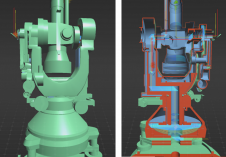
Since the coloured point cloud of the WILD T2 was about 600MB in size, it could not serve as 3D base model in the app. Therefore, a transformation process was necessary to convert the point cloud into a vectorized 3D model. Techniques to automatically transform point clouds into kinematic 3D models, e.g. using machine learning (ML) and deep learning (DL) methods, are still in the early stages and therefore have very limited application, although that may change fundamentally in the next five to ten years. In this case, the point cloud was transformed into 3D CAD elements in an interactive computer graphics process called constructive solid geometry (CSG). This breaks down the point cloud model into its vectorial components and these are then textured accordingly (Fig. 6). The CSG 3D model could then be textured with the WILD T2 texture from the past decades, animated and dynamized as desired: rotation around the alidade axis, telescope traversal, tilted and zoomed. Moreover, a decomposition into the optical components (using sectional drawings) allows for camera flights along the ray paths for the horizontal and vertical circles, representation of axes systems, and much more. Users of the app user can also play around with the 3D virtual reality (VR) model – or ‘digital twin’ – of the T2.

应用程序运行在全景模式和屏幕is subdivided into three parts: the story headings on the left, the stories with images in the middle and the help symbols on the right. 3D models and animations are displayed in the middle of the screen and symbolized by the rotating cube symbol. The buttons on the top left lead to the story headings and to the home screen. Audio embedded in the corresponding stories can be activated using the loudspeaker button. The 15 stories provide app users with a comprehensive overview of the company history and its locations over time, the T2 features and updates, and some interior elements of the theodolite which are animated to demonstrate its compact and revolutionary design.

Animations and rendering
使用Autodesk 3ds Max生成所有交互式计算机图形3D模型。点云仅用于缩放最终的3D CSG模型。根据选定的时间点,T2随时间(1923-1995)的照片(1923-1995)用于纹理数字双胞胎。该应用程序提供了三个数字双胞胎,用于以下时间段:1922,1929和1962年。用于创建具有许多设计元素的非常详细的3D模型,其中若干横截面模型(其中一个横截面模型(其中一个)用于创建一个非常详细的3D模型。user can also ‘explode’. This feature is aimed at inspiring the younger generation about the possibilities of interactive computer graphics, which can also be used to provide impressive animations and simulations in sectors where 3D data capture is emerging, such as architecture, engineering & construction (AEC).

使用Unity 3D游戏引擎集成到应用程序中的3D文本,音频,图像序列和3D模型。这使得启用动画交互式3D模型将导出和呈现,最终为移动操作系统(例如Android和IOS)准备。在此处理步骤中,还生成了窗口版本以缩放多个屏幕分辨率。图。图8示出了故事15的摘录,其具有通过光学系统的动画飞行,用于读取水平和垂直圆。
Conclusion
The WILD T2 theodolite was a milestone in geodetic instrument development. For more than seven decades, it had the most modern design and revolutionary features of its time, such as the cylindrical standing axis, horizontal and vertical circles made of glass, diametrically readable graduated circles, precise readings by coincidence micrometers, a compact telescope and low weight. By summarizing the most important facts and features of this innovative and bestselling theodolite, the WILD T2 app recognizes the outstanding performance of the engineers, technicians and managers at Heerbrugg, within the company that is today known as Leica Geosystems and part of Hexagon – over the past 100 years. The developers hope that the WILD T2 app will contribute to the public understanding of science and technology by presenting 15 stories about the background of WILD Heerbrugg and the T2 including a variety of 3D reconstructions, visualizations, animations, image sequences and audio. In these times of digitalization and new didactic elements in higher education, it is hoped that the app will help students and also the general public to gain a better understanding of the history of geodesy and geoinformation science through the playful use of new technologies.
Further reading
免费下载Wild T2应用程序:
Android:https://play.google.com/store/apps/details?id=NET.SREASONS.WILDT2
iOS:https://apps.apple.com/us/app/wild-t2/id1564103981

Make your inbox more interesting.添加一些地理。
Keep abreast of news, developments and technological advancement in the geomatics industry.
免费注册